By Mehmood Sajjad, SEO Specialist at Marketing Glob Hub — Last updated: August 2026
Technical SEO Guide for 2026
Technical SEO Guide for 2026 is essential for bloggers and affiliate marketers. If you’re a blogger or affiliate marketer, you already know that great content alone isn’t enough to rank on Google. Behind every high-ranking page is a technically sound website. This guide breaks down exactly what technical SEO is and what you need to do today to make Google love your site. This Technical SEO Guide for 2026 will help you to understand how search engines crawl and index your website effectively.
Technical SEO in 2026 is no longer optional; it’s the foundation of ranking any blog or affiliate website successfully.
For bloggers and affiliate website owners, technical SEO can help prevent common problems such as indexing issues, slow pages, broken links, poor mobile usability, and confusing site structures.
Even if your content is high-quality, poor technical SEO can stop your site from being indexed, ranked, or even discovered by search engines.
In this complete guide, you’ll learn how to fix technical issues, improve site performance, and boost your rankings fast using proven strategies.
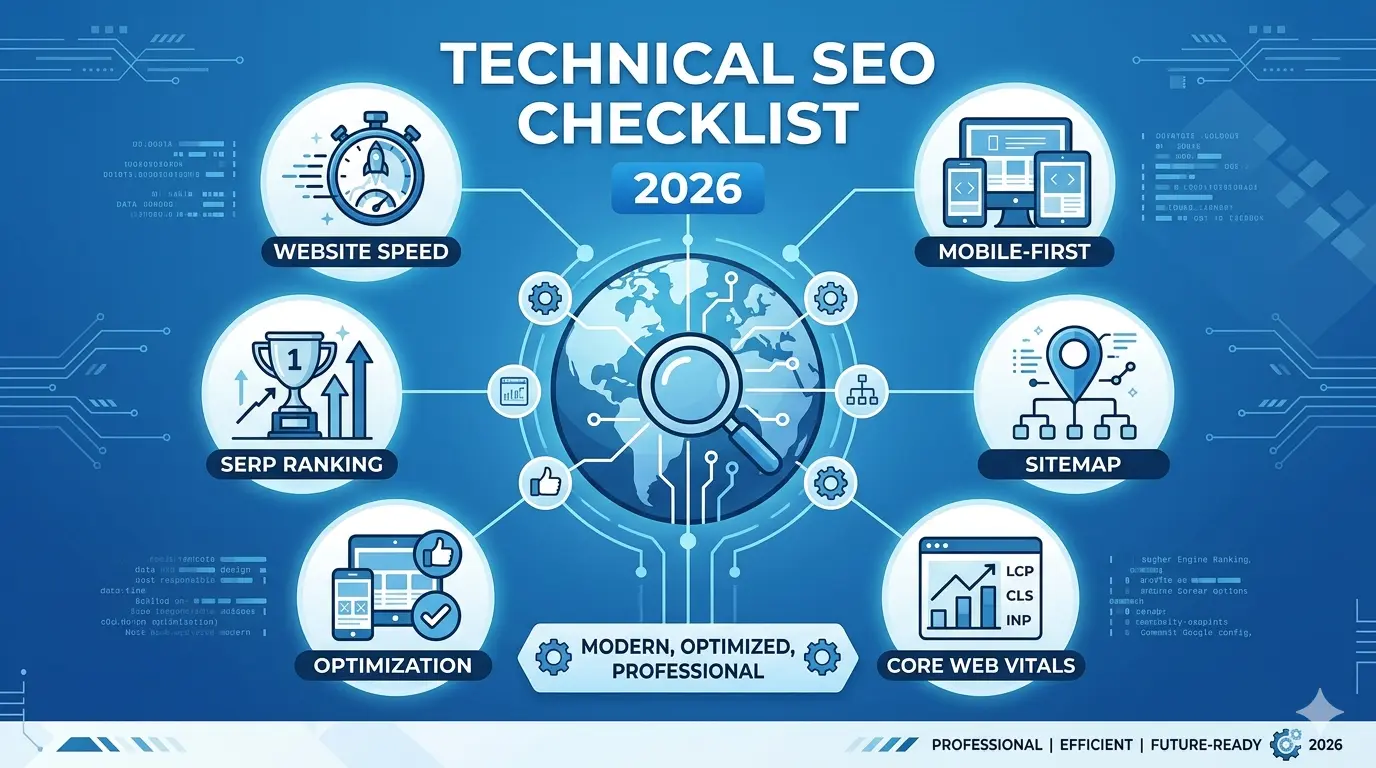
✅ Technical SEO Checklist for 2026
- Optimize Core Web Vitals
- Fix crawl errors in Google Search Console
- Improve website speed
- Use clean URL structure
- Add schema markup
- Optimize XML sitemap
- Ensure mobile-friendliness
- Fix broken links
- Use HTTPS
- Improve internal linking
Table of contents:
- What is technical SEO and why does it matter?
- Site speed: your #1 ranking factor.
- Mobile-first indexing explained.
4. Crawlability and indexing basics:
– XML Sitemap
– Robots.txt file
5. HTTPS and Core Web Vitals.
6. Internal linking for affiliate sites.
7. Technical SEO quick-action checklist.
1. What is Technical SEO and why its useful?
Technical SEO is the process of optimizing your website’s structure, speed, and indexing to help search engines to crawl and rank your content efficiently and more efficiently. Technical SEO refers to the behind-the-scenes optimizations that help search engines like Google find, crawl, understand, and index your website.
While on-page SEO focuses on content and keywords, technical SEO is about your website’s structure, speed, and health.
For bloggers and affiliate marketers, ignoring technical SEO means leaving rankings and revenue on the table — no matter how good your content is. Google will not rank a slow, poorly structured website above a fast and technically clean one.
2. Site Speed: Why Website Performance Matters for SEO
Google uses page experience signals, including Core Web Vitals, to evaluate aspects of the experience users have on a page. Website performance is therefore an important part of creating a fast and user-friendly website, although it should not be treated as the single most important Google ranking factor.
How to improve your site speed today
Start by running your website through Google PageSpeed Insights (free tool). Focus on these quick wins:
- Compress all images using tools like TinyPNG or ShortPixel
- Enable browser caching via your hosting or a plugin like WP Rocket
- Use a lightweight theme — avoid heavy page builders
- Enable lazy loading for the images below the fold to get faster speed.
- Use a Content Delivery Network (CDN) like Cloudflare (free); it is also very useful.
Pro tip: For affiliate sites, fast loading on mobile is critical. Most of your audience will come from mobile search. Test your mobile speed separately from desktop.
3. Mobile-first indexing explained
Since 2023, Google indexes the mobile version of your website first. This means if your site looks broken or slow on mobile, your rankings will suffer — even for desktop searches. Make sure your WordPress theme is fully responsive, your font sizes are readable on small screens, and buttons are easy to tap.
4. Crawlability and indexing basics
Google uses bots (called “crawlers”) to explore your website. If these bots can’t access your pages, your content will never rank. Here’s what you need to check.
Blocking low-value pages improves crawl efficiency and helps Google index important pages faster
XML Sitemap
A sitemap is a file that tells Google all the pages on your website. If you use WordPress, install Yoast SEO or Rank Math, and it will generate a sitemap automatically. After this, submit it to the Google Search Console at: yourdomain.com/sitemap.xml.
Robots.txt file
This file tells Google which pages to crawl and which to skip. Never accidentally block your main content pages. You can check yours at yourdomain.com/robots.txt.
Common mistake: Many bloggers accidentally block their entire site in robots.txt after a WordPress update. Always double-check this file after major plugin updates.
🔍 Importance of XML Sitemap and Robots.txt
An XML sitemap acts like a roadmap for search engines. It tells Google which pages are important and should be indexed. In this Technical SEO Guide for 2026, creating and submitting a sitemap is a must-do step. You can easily generate one using SEO plugins like Rank Math or Yoast SEO.
On the other hand, the robots.txt file controls which parts of your website search engines can access. It is important to ensure that you are not accidentally blocking important pages. A small mistake in this file can prevent your entire website from appearing in search results.
📱 Mobile Optimization is No Longer Optional
In 2026, more than half of web traffic comes from mobile devices. That’s why mobile optimization is a key part of this Technical SEO Guide for 2026. Your website should be fully responsive, meaning it works smoothly on all screen sizes.
Make sure:
- Text is easy to read without zooming
- Buttons are easy to click
- Pages load quickly on mobile networks
Google uses mobile-first indexing, which means it primarily uses the mobile version of your site for ranking. If your mobile experience is poor or not good, your rankings will suffer as a result.
🔗 Internal Linking Strategy
Internal linking is often ignored, but it plays a powerful role in SEO. By linking one page to another within your website, you help search engines understand your content better. It also keeps visitors on your site longer.
For example, if you have another blog about “On-Page SEO,” you can link it naturally within your article. This not only improves SEO but also increases page views and user engagement.
5. HTTPS and Core Web Vitals
If your website still uses HTTP instead of HTTPS, this is an immediate fix you must make today. Google flags non-HTTPS sites as “Not Secure” and actively deprioritizes them in rankings. Contact your hosting provider to enable a free SSL certificate via Let’s Encrypt.
Core Web Vitals
Core Web Vitals are a set of metrics Google uses to measure user experience on your site. The three key metrics are:
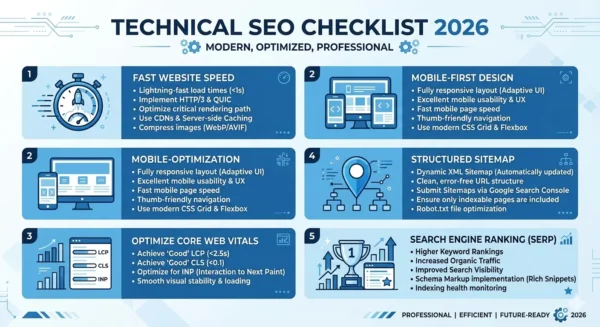
- LCP (Largest Contentful Paint) — how fast your main content loads; what is its speed?. Target: under 2.5 seconds.
- INP (Interaction to Next Paint) — how fast your page responds to clicks. Target: under 200ms.
- CLS (Cumulative Layout Shift) — how stable your layout is. Target: under 0.1. (Avoid ads or images that shift your content around.)
6. Internal linking for affiliate sites
Internal links are links from one page on your site to another. They help Google understand the structure of your site and distribute “link authority” across your pages. For affiliate marketers, a smart internal linking strategy can push your money pages higher in rankings.
Best practice: whenever you publish a new article, link to at least 2-3 existing related posts. And go back to older posts to add links pointing to the new one. This creates a strong content network Google can easily crawl.
On a recent client project, we reduced image size from 2MB to 200KB and saw LCP improve from 4.2s to 1.8s.
Affiliate tip: Always link your highest-earning affiliate posts from your most-visited pages. This sends Google’s trust signals toward your most important content.
7. Technical SEO quick-action checklist
Use this checklist to audit your blog or affiliate site right now:
- Google Search Console is set up, and the sitemap is submitted.
- Website loads in under 3 seconds on mobile.
- HTTPS (SSL) is enabled — URL starts with https://
- All images have descriptive alt text with keywords.
- No broken links (check with Broken Link Checker plugin).
- Robots.txt file is not blocking important pages.
- Core Web Vitals pass in Google Search Console.
- Internal links connect related posts and money pages.
- Each page needs a unique title tag and meta description.
- No duplicate content or thin pages (under 300 words).
🔥 My Results After Fixing Technical SEO
After improving technical SEO on my website, I noticed faster indexing and better impressions in Google Search Console.
Fixing internal linking and page speed made the biggest difference in improving rankings.
Advanced Technical SEO Strategies for 2026
✅ 1. Crawl Budget Optimization
Crawl budget refers to the number of pages search engines crawl on your website within a given time.
- Remove duplicate pages
- Fix broken links
- Optimize internal linking
- Block unnecessary pages via robots.txt
For example, removing 50+ duplicate pages from a blog improved crawl efficiency and helped Google index important pages faster.
For large websites, optimizing crawl budget ensures that important pages are indexed faster.
2. JavaScript SEO Issues
📌 JavaScript SEO Optimization
Websites that use heavy JavaScript can face indexing issues because search engines may struggle to render their content properly.
- Use server-side rendering (SSR)
- Avoid hiding important content in JS
- Test using Google Search Console
3. AI Crawlers Optimization (VERY IMPORTANT IN 2026)
📌 Optimizing for AI Crawlers
Modern search engines and AI tools use bots like GPTBot to extract and summarize content.
- Use clear headings
- Write short answers
- Structure content properly
Optimizing your content for AI improves visibility in AI-generated search results.
4. Fixing Rendering Issues
📌 Rendering & Indexing Issues
- check “URL Inspection” in Search Console
- Fix blocked resources
- Ensure CSS & JS are crawlable
Why Advanced Technical SEO Matters
Basic technical SEO helps your website function properly, but advanced optimization gives you a competitive edge and improves ranking performance significantly.
FAQ:
Q: What is Technical SEO in 2026?
Technical SEO focuses on optimizing website structure, speed, and indexing to improve search rankings.
Q: Why is Technical SEO important?
It helps search engines crawl your site efficiently and improves user experience.
Q: How often should I update Technical SEO?
You should review your technical SEO every few months to fix errors and stay updated.
Final thoughts
Technical SEO is not a one-time task — it’s an ongoing maintenance habit. But the good news is that getting the basics right puts you ahead of the majority of bloggers and affiliate marketers who focus only on content. Fix your speed, set up Search Console, secure your site with HTTPS, and build a solid internal linking structure. These fundamentals compound over time and create a strong foundation for long-term organic growth.
Technical SEO in 2026 focuses on improving website performance, structure, and crawlability to boost rankings.
By fixing errors, improving speed, and using proper optimization techniques, you can significantly increase your website traffic.
Need help with a full technical SEO audit of your site? Marketing Glob Hub offers professional SEO services starting at $50/month. Get in touch today.