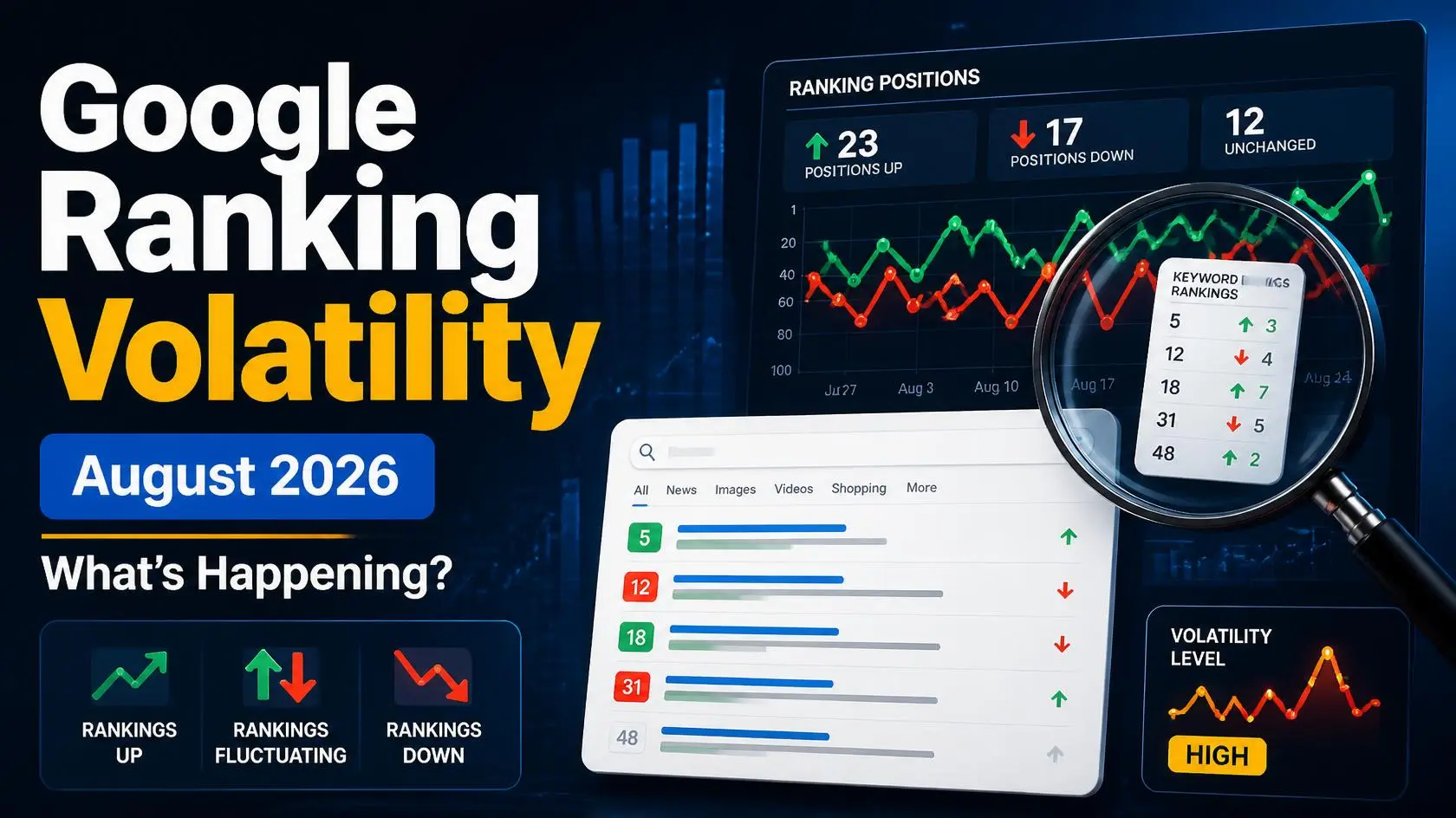
Google ranking volatility in August 2026 has increased, but there’s no need to panic yet. Since the start of August, SEO tracking tools and industry forums have reported noticeable ranking swings across Google Search. Here’s what’s actually known so far, and what you should — and shouldn’t — do about it.
What’s Actually Happening
Starting around August 1st, several third-party rank-tracking tools began showing a sharp spike in ranking volatility across Google Search results. This kind of spike usually means one thing: pages are moving up and down in the rankings more than usual, sometimes significantly, within a short window of time.
At the same time, chatter picked up across SEO forums and communities, with site owners and marketers comparing notes on unusual movement in their own rankings. When multiple independent tracking tools show elevated volatility at the same time that SEO professionals report unusual ranking changes, it is reasonable to suspect that Google’s search results are experiencing broader movement. However, that evidence alone does not tell us exactly what caused the changes or whether Google has released a specific algorithm update.
Important honesty check: as of this writing, Google has not issued an official confirmation naming a specific new algorithm update. Volatility spikes like this sometimes turn out to be a confirmed, named update. Other times, they settle down within a few days without any official acknowledgment at all. Be cautious of anyone claiming to know exactly what changed with total certainty this early — the honest answer right now is that we’re watching it unfold.
Google Ranking Volatility August 2026: What We Know: What We Know
Last updated: August 6, 2026
Google Search has shown increased ranking volatility since around August 1, with multiple third-party tracking tools and SEO communities reporting unusual movement. However, Google has not officially confirmed a new August 2026 core update at the time of writing. Google’s Search Central documentation explains that Google makes ongoing changes to its ranking systems, while larger core updates are announced separately.
Why This Keeps Happening
Google regularly makes changes to its search systems, and major updates are documented through its official Google Search ranking updates resources. Occasionally, a change is significant enough that it shows up clearly across multiple independent tracking tools at once, which is what appears to be happening this time.
It’s also important not to assume that every period of volatility has one single cause. Google continually makes changes to its search systems, and search results are dynamic. Google’s own guidance notes that rankings can change as its systems evolve and as the web and user expectations change.
Should You Actually Be Worried?
Let’s break down the honest answer based on what you’re actually seeing.
If your rankings haven’t moved: No action needed. Plenty of sites see zero impact from any given update, especially smaller or more focused sites outside the specific pages or content types affected.
If you’ve seen a small, temporary dip: This is common during any volatility window, even for healthy sites. Give it a few days to a week before assuming something is fundamentally wrong — rankings often settle back close to where they were once the dust clears.
If you’ve seen a significant, sustained drop: This is worth investigating, but don’t jump to drastic changes immediately. Check whether the drop is isolated to specific pages or site-wide, and review those pages against Google’s general quality guidance — helpful content, clear expertise, and technical health remain the most reliable long-term factors regardless of any single update.
If you’ve seen an increase: Great, but don’t over-credit any recent changes you made unless you have a clear reason to believe they caused it. Volatility periods can boost rankings just as easily as they can lower them, for reasons that aren’t always tied to anything you specifically did. Check whether the drop is isolated to specific pages or site-wide, and review your pages against Google’s general quality guidance. You can also learn more about how to write SEO blog posts for Google and AI search to strengthen your content.
What to Actually Check on Your Site Right Now
Look at your analytics over the past 5-7 days, not just the past 24 hours — short-term noise is common during volatility windows and doesn’t always reflect a lasting change
Check if the movement is page-specific or site-wide — this tells you whether to investigate individual content or broader technical/quality factors
Check your top-performing pages against the core quality basics — direct answers, real expertise, factual accuracy, and solid technical health. For a deeper look at technical improvements, see our Technical SEO Guide for 2026.
Avoid panic-editing everything at once — making a lot of changes simultaneously during a volatility window makes it hard to tell what actually helped or hurt later.
Check Google Search Console for any manual actions or security issues to rule those out as unrelated causes. You can also review your site’s Core Web Vitals to identify potential page-experience issues.
Compare your Google Search Console data with the same period from the previous week and previous month. Look at clicks, impressions, average position, and the specific pages and queries that changed. This can help you distinguish a temporary ranking fluctuation from a broader traffic trend.
Check whether the change is coming from Search overall or from specific queries/pages. A drop in one keyword does not necessarily mean your entire site has been affected.
If you’re seeing changes that may be related to crawling or indexing, our guide to crawl budget for small blogs explains what to check.
How to Tell a Real Update From Normal Fluctuation
Rankings shift constantly in small ways — that’s completely normal and not something to react to. A genuine update is more likely when you see:
Multiple independent rank-tracking tools showing the same spike at the same time
Widespread discussion across SEO communities, not just a handful of isolated complaints
Movement that’s broad across many sites and niches, rather than confined to your site alone
If you’re only seeing movement on your own site with no wider pattern elsewhere, it’s more likely something specific to your site (a technical issue, a content change, a crawl problem) rather than a broader Google update.
Frequently Asked Questions
Has Google confirmed an August 2026 core update?
Not at the time of writing. Third-party tracking tools and SEO-community discussions indicate elevated ranking volatility, but Google has not officially announced a specific August 2026 core update. Check Google’s Search Status Dashboard and Search Central’s ranking-update documentation for the latest information.
Is now the right time to start making changes to my site over this?
Generally, no — not reactive, panic-driven changes. It’s a good time to review your fundamentals, but wait for the volatility to settle before drawing firm conclusions about what specifically caused any changes you’re seeing.
How long do these volatility periods usually last?
It varies. Some settle within a few days; others take one to two weeks before rankings stabilize. Patience is usually the right approach unless you’re seeing a severe, sustained drop. If you’re trying to determine whether a temporary ranking change is actually affecting your SEO performance, you can also read How Long Does SEO Take to Work?.
Does this affect small blogs as much as large sites?
Not necessarily equally. Broad updates can affect sites of any size, but smaller, focused sites are sometimes less exposed simply because they compete in narrower, less contested spaces.
Where can I track this as it develops?
Third-party SEO tracking tools (which monitor ranking volatility in aggregate) and established SEO news/forum sites tend to report on these situations quickly, often before any official Google confirmation.
Why are my Google rankings suddenly fluctuating?
Google Search results naturally change as its ranking systems evolve, new content appears, existing pages are updated, and user search behavior changes. During periods of broader volatility, these movements can become more noticeable. A temporary change does not necessarily mean your website has been penalized or affected by a specific algorithm update.
Final Thoughts
Ranking volatility like this can feel alarming in the moment, especially if you’re watching your own numbers move day to day. But the healthiest response is usually the same one that works regardless of any single update: keep your site technically clean, keep your content genuinely useful, and give any volatility window time to settle before making major decisions.
If your fundamentals are solid, short-term swings like this one tend to be exactly that — short-term.
Rather than reacting to every ranking fluctuation, focus on creating useful content around topics your audience actually searches for. Our guide on finding low-competition keywords without paid tools can help.
Want a second opinion on whether recent ranking movement reflects a real issue with your site? Marketing Glob Hub offers technical SEO reviews starting at $50/month — get in touch to get started.