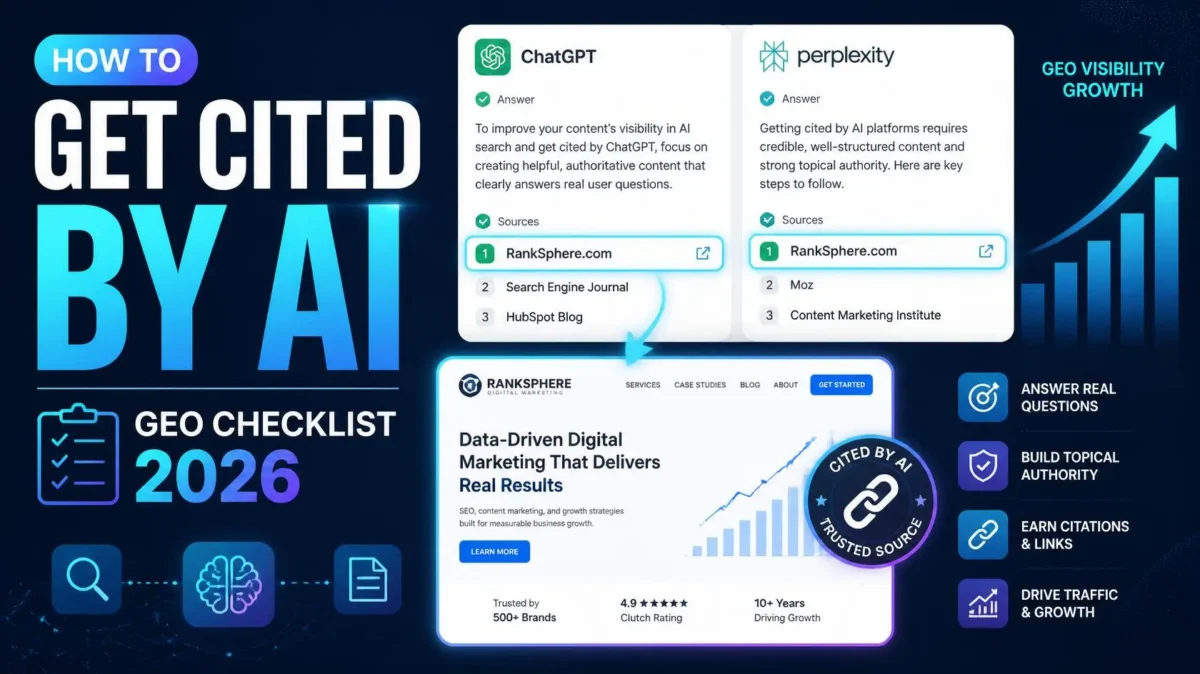
How to Get Cited by ChatGPT and Perplexity: A Practical GEO Checklist for 2026
To increase your chances of being cited by ChatGPT and Perplexity, create clear, authoritative, easily extractable content, support claims with credible sources, demonstrate topical expertise, maintain strong technical accessibility, and answer specific user questions directly.
Search is splitting into two lanes. There’s still the classic blue-link Google, and now there’s a fast-growing lane where people ask ChatGPT, Perplexity, Copilot, or Google’s AI Overviews a question and get a written answer with a handful of sources cited underneath it. Getting into that citation list is a completely different game than ranking #1 on a SERP — and most sites are still only playing the old game.
This is Generative Engine Optimization (GEO): the practice of structuring your content so AI answer engines can find it, trust it, and quote it. This guide walks through why GEO works differently from SEO, a full checklist you can act on today, real examples of extractable vs. non-extractable writing, the mistakes that quietly kill your citation odds, and how to track whether any of it is working.
Why GEO Is Different From Traditional SEO
Traditional SEO optimizes for a ranking algorithm that returns a list of links, and a human being scans that list and clicks the one that looks best. Generative engines skip that step. Generative search systems may retrieve information from your page, identify claims relevant to a user’s question, and decide whether to cite your page as a source or use the information in a broader summary.
A few consequences follow from that:
- Structure matters more than keyword density. Old-school SEO rewarded repeating your target phrase enough times. AI systems generally don’t benefit from keyword stuffing; they need clear, well-bounded information: a definition, a step, a stat, a comparison. Pages that bury the answer inside long, meandering paragraphs are much harder to lift a clean quote from.
- Trust signals matter more than backlinks alone. Backlinks and mentions can contribute to a site’s overall authority and discoverability, but they are only one part of a much larger picture; models also weigh things like consistent authorship, whether your claims match what other trusted sources say, and whether the page reads like it was written by someone who actually knows the subject versus content assembled to rank.
- Freshness and specificity beat generic breadth. A page with an original stat, a dated example, or a named source is far more citable than a page that restates common knowledge in slightly different words. Generic content is redundant to a model that has already ingested a hundred versions of the same generic explanation.
- Being present isn’t enough — being extractable is what counts. Ranking #3 on Google doesn’t guarantee a spot in the AI Overview or a Perplexity answer for that same search — your content can technically contain the answer and still get skipped if it doesn’t present that information in a form a model can easily understand and extract.
Real Example: Non-Extractable vs. Extractable Writing
Non-extractable (buried answer):
With regular WhatsApp outreach (3–5 customer touches weekly), small businesses generally notice real results in the 8- to 12-week range..
The answer is buried inside a long sentence and surrounded by several conditions, making the key information less immediately clear to a reader or an automated system.
Extractable (direct answer):
Example: With regular WhatsApp outreach, a small business might evaluate results over an 8- to 12-week period, depending on its audience, offer, message volume, and conversion cycle.
Same underlying idea, but the second version gives a model a clean, specific, quotable fact with a stated condition attached. That’s the difference GEO writing makes.
How to Get Cited by ChatGPT and Perplexity: GEO Checklist
1. Give the Answer Before the Buildup
Lead with a direct answer. Clear answers near the beginning make your page easier for readers, search systems, and AI systems to understand and extract. If your target question is “What is X?” or “How do I do Y?”, give a full, direct answer right away — skip the intro paragraph, backstory, or ‘here’s what we’ll cover’ preamble. Save scene-setting and elaboration for after the answer, not before it.
2. Write in extractable chunks
Break content into short, self-contained units: a numbered list, a definition box, a short Q&A, a comparison table. Each chunk should make sense pulled out of context, because that’s exactly what a model does with it. Avoid multi-sentence claims that depend on the paragraph before them to make sense. A good test: could you copy any 2–3 sentence block from your page and paste it standalone into a chat window, and would it still read as a complete, accurate answer? If not, rewrite it.
3. Use structured data markup
Add Schema.org markup where relevant, and follow Google’s Article structured data documentation when implementing Article or BlogPosting markup. This doesn’t guarantee a citation, but it gives crawlers unambiguous signals about what type of content is on the page and who wrote it, which helps machine parsers categorize and trust it. If you’re on WordPress, a plugin like Rank Math or Yoast can generate most of this automatically — just make sure it’s actually configured per page, not left on defaults.
4. Cite your own sources and data
Pages that reference original data, named studies, or dated examples read as more authoritative to a model deciding what to attribute. If you ran your own survey, published a case study, or have real client numbers, put the actual figures in the text — not just “significant improvement,” but “42% increase in organic traffic over 90 days, based on a client campaign for a 3-person e-commerce team.” Specificity is what separates a citable source from a paraphrasable one.
5. Build topical depth, not just page count
Consistent topical coverage can make it easier for search and AI systems to understand your site’s expertise and the scope of the topics you cover. A pillar page supported by 4–6 spoke articles on closely related sub-questions signals topical depth, which raises the odds that any one of those pages gets pulled into an answer. This is also why your existing content clusters — like your WhatsApp Business series or your AI-search/SEO series — are worth more than the sum of their parts if you keep them tightly interlinked.
6. Keep an author identity attached to the content
Clear bylines, author bio pages, and consistent authorship help readers and search systems understand who is responsible for the content and what experience they bring to the topic. An anonymous, unattributed post is easier to skip than one with a named, credentialed author. If you’re already putting “Written by Mehmood Sajjad” on your pages, make sure that name links to a real author bio page with credentials — that consistency reinforces trust signals over time. Google also recommends providing author information and linking the author to a page that identifies them, such as an author bio or profile page.
7. Check AI Crawler Access and Technical SEO
Check Google’s crawling and indexing documentation and make sure your pages are crawlable, indexable, included in your sitemap, and accessible without unnecessary technical barriers. Also review Google’s robots.txt documentation before changing your robots.txt rules. If you use an llms.txt file, treat it as an optional emerging convention rather than a guaranteed way to improve AI citations.
8. Monitor what’s already being cited in your niche
Before writing, ask ChatGPT or Perplexity the exact question you’re targeting and see who gets cited. That tells you two things: whether the topic is already being answered well (harder to break in) and what gaps or outdated info exist in the current top answers (your opening). If three different tools keep citing the same outdated stat or the same thin page, that’s a strong signal you can out-write it.
9. Refresh instead of republish
Keeping important pages accurate and up to date can improve their usefulness and credibility, especially for topics where facts change quickly, even when the old page still ranks well in classic search. Revisit your best-performing pages every few months, update stats and examples, and keep the publish/modified date current rather than starting a brand-new page from scratch each time.
10. Write for the follow-up question, not just the first one
People chatting with an AI assistant rarely stop at one question — they ask a follow-up. If your page also answers the two or three natural follow-ups to your main topic (in the same structured, extractable way), you give your content more opportunities to be relevant when users ask follow-up questions about the same topic.
Common Mistakes That Quietly Kill Your GEO Odds
- Keyword-stuffed intros that delay the actual answer. If a reader (or a model) has to scroll past 300 words of throat-clearing to find your point, you’ve already lost the extraction race to a competitor who led with the answer.
- Hedged, vague claims. “It depends” and “results may vary” are honest, but if that’s the entirety of your answer, there’s nothing citable in it. Give the specific, common-case answer, then note the exceptions after.
- No clear authorship. Content with no named author, no bio, and no credentials is easy for a model to treat as lower-trust filler.
- Duplicating what everyone else already says. If your page says the same thing as the top five existing sources with no new data, no new angle, and no original example, a model has no reason to prefer citing you over the source it already trusts.
- Ignoring technical access. Even excellent content can’t be cited if it’s blocked by robots.txt, gated behind aggressive JavaScript rendering, or missing from your sitemap.
- Treating GEO as a one-time project. Which sources get cited can change as models are retrained and content gets re-crawled. A page that gets cited today can lose that spot in a few months if it isn’t kept current.
| GEO Factor | What to Do | Why It Matters |
|---|---|---|
| Direct answers | Answer the main question immediately | Makes the key information easier to understand and extract |
| Extractable content | Use short paragraphs, lists, tables, and clear definitions | Gives AI systems clearly defined information |
| Original information | Add your own data, examples, tests, or case studies | Helps differentiate your content from generic articles |
| Topical authority | Build related articles and connect them with internal links | Establishes deeper coverage of the subject |
| Author credibility | Add a clear byline and author bio | Helps demonstrate who is responsible for the content |
| Technical accessibility | Check crawlability, indexability, robots.txt, and sitemap | Helps search and AI systems access your content |
| Freshness | Update statistics, examples, and outdated information | Keeps important information accurate |
| Follow-up questions | Answer related questions users are likely to ask next | Expands the usefulness of the page |
Simple Tools Worth Using
- ChatGPT and Perplexity themselves — the fastest, free way to audit what’s currently being cited for your target questions. If you’re also looking for AI tools that can support your marketing workflow, see our guide to the best AI marketing tools in 2026.
- Google Search Console — to find questions and long-tail queries you’re already getting impressions for, which are strong GEO candidates since you already have some relevance signal.
- Schema markup validators (Google’s Rich Results Test, Schema.org’s own validator) — to confirm your structured data is actually parsing correctly, not just present in your code.
- A simple content audit spreadsheet — track each target question, who currently gets cited for it, and whether your page has been checked/updated in the last 90 days.
A Simple Starting Workflow
- Pick 5–10 questions your ideal customer would type into ChatGPT or Perplexity about your niche.
- Ask each question in both tools and note who currently gets cited and what, specifically, they’re being credited for.
- For each gap or weak answer, write (or rewrite) a page that leads with a direct answer, breaks the rest into extractable chunks, and adds one original data point or example.
- Add relevant schema markup and a clear author byline linked to a real bio page.
- Confirm that your robots.txt isn’t unintentionally blocking important crawlers, and check that your pages are crawlable, indexable, and included in your sitemap. If you use llms.txt, treat it as an optional emerging convention rather than a requirement for AI visibility.
- Re-ask the same questions monthly and log whether your citations start appearing.
- Refresh your highest performers every 60–90 days rather than letting them go stale.
Frequently Asked Questions
Does GEO replace SEO?
No. Classic search still drives the majority of traffic for most sites today. GEO is an additional layer that makes your existing content more likely to also surface in AI-generated answers — the two overlap far more than they conflict.
When Should You Expect a Citation to Show Up?
There’s no fixed timeline, since it depends on how often a given model’s index or retrieval layer refreshes and how competitive the question is. Treat it the way you’d treat SEO results: expect weeks to a few months, not days.
Is a Full Site Rewrite Necessary?
No — start with the pages closest to already ranking or getting impressions in Search Console. Those already have partial relevance signal, so a structural rewrite is the highest-leverage first move.
Is there a guaranteed way to get cited?
No tool or tactic guarantees a citation, since the model ultimately decides what to surface. GEO improves your odds by making your content easier to find, trust, and extract — it doesn’t force an outcome.
The Bottom Line
GEO isn’t a replacement for SEO — it’s an added layer on top of it. The sites that win in both lanes are the ones writing clear, well-structured, genuinely useful answers with real expertise behind them. If your content already ranks reasonably on Google, most of the work here is reformatting and sharpening what you have — leading with the answer, breaking it into extractable chunks, adding real specifics — rather than starting from scratch.
Start with one article already receiving Google impressions. Rewrite its key sections into direct, extractable answers, add credible sources, strengthen internal links, and monitor whether your target questions begin producing AI citations.