Rankings Fine, Traffic Down? The AI Overview Problem in 2026
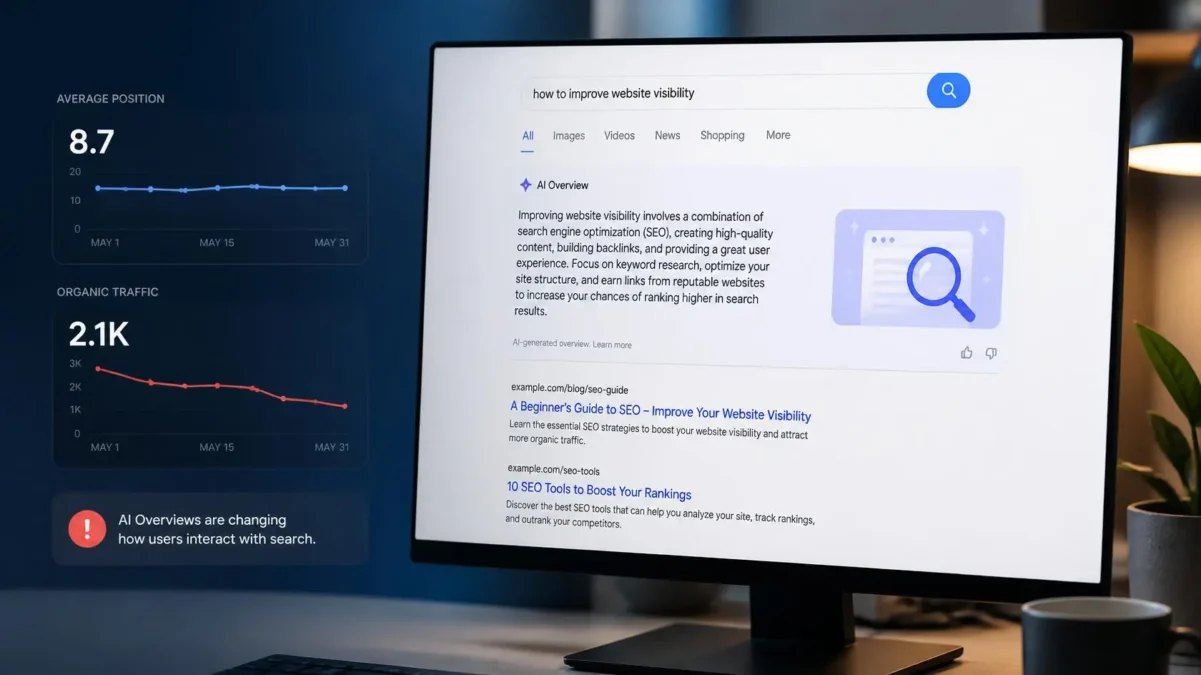
An AI overviews traffic drop can be one possible reason your organic clicks are falling even when your Google rankings appear stable.
You may be looking at your Google Search Console data and wondering what happened.
Your important keywords are still ranking. Your pages haven’t suddenly disappeared. There may not be a major technical SEO problem. Yet, the number of clicks coming from Google is lower than it used to be.
This is one of the most frustrating situations for website owners and SEO professionals.
And one possible reason is the changing Google search results page, particularly AI Overviews.
AI Overviews can give searchers an AI-generated summary directly on the search results page. In some searches, users can get useful information without immediately clicking a traditional blue organic result. Google’s guidance on AI search experiences also emphasizes creating unique, valuable content that goes beyond basic information.
That creates an important SEO question:
What happens when your ranking stays the same, but fewer people feel the need to click?
Let’s look at what is happening, what you should check, and what website owners can do about it.
What Are Google AI Overviews?
Google AI Overviews are AI-generated summaries that can appear at the top of certain Google search results.
Instead of showing only a list of traditional search results, Google may provide a summary designed to answer the user’s question directly. The overview can also include links to websites that Google considers relevant to the answer.
This changes the way people interact with the search results.
Previously, a user might search for something, scan several results, and click the page that looked most useful.
With an AI-generated answer appearing prominently on the results page, the user may get enough information to decide that another click isn’t necessary.
That doesn’t mean every search produces fewer clicks.
It does mean website owners need to think about visibility and clicks separately.
The Problem: Your Rankings Can Be Fine While Your Traffic Falls
This is the part that many website owners find confusing.
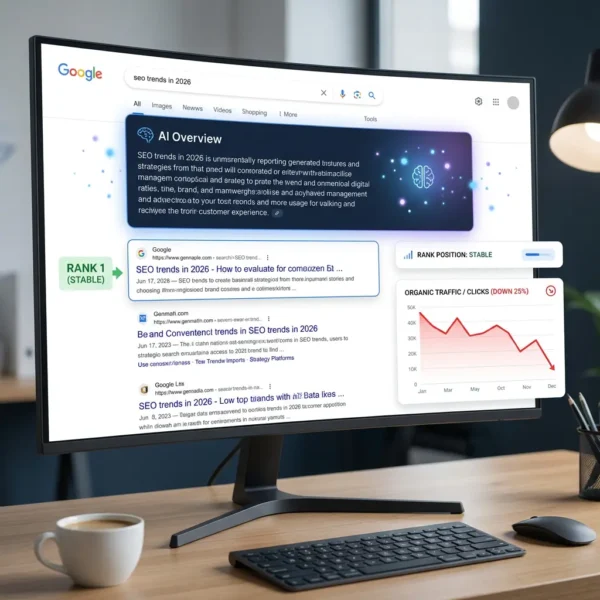
Imagine that one of your articles ranks around position three for an important keyword.
Last year, perhaps 1,000 people searched for that query and a significant number clicked the organic results.
Now imagine the search results page has changed.
An AI Overview appears above the traditional results and answers part of the user’s question immediately.
Your article might still appear around position three.
From a ranking perspective, everything looks fine.
But the number of people reaching your page can still decrease.
This is why looking at rankings alone can give you an incomplete picture of SEO performance. If you’ve noticed unusual ranking fluctuations recently, see our guide to Google ranking volatility in August 2026 for more context.
A better approach is to monitor:
- Search impressions
- Organic clicks
- Click-through rate
- Average position
- Queries bringing traffic
- Pages losing clicks
- Changes in search intent
The relationship between these numbers can tell you much more than your ranking position alone.
If you’ve noticed unusual ranking fluctuations recently, see our guide to Google ranking volatility in August 2026 for more context.
AI Overviews Aren’t Always the Enemy of Your Website’s Visibility
It is important not to blame every traffic decline on AI Overviews.
Search traffic can change for many reasons.
For example, your traffic may fall because:
- Search demand changed
- A competitor improved their content
- Search intent changed
- Google changed the search results layout
- A seasonal trend ended
- Your page became less relevant
- Your title became less attractive
- A core or spam update affected visibility
- Another SERP feature appeared
- Users are searching differently
- Your rankings declined for valuable queries
Before assuming that a search-related change is responsible, it’s also worth reviewing your site’s technical SEO health. Our technical SEO guide for 2026 covers important technical factors that can affect search visibility.
AI Overviews are only one part of a much larger search ecosystem.
That distinction matters because randomly changing your entire SEO strategy after seeing lower traffic can make the situation worse.
First, find out where the decline actually happened.
How to Diagnose an AI Overviews Traffic Drop
If you’re investigating an AI Overviews traffic drop, start by comparing your Google Search Console data before and after the decline. Open the Performance report and compare your recent search data with an earlier period.
Open the Performance report and compare your recent search data with an earlier period.
Look at four important metrics:
1. Impressions
Are people still seeing your pages in Google?
If impressions have fallen significantly, your visibility may have changed.
2. Clicks
Are fewer people visiting your website from Google?
This is the metric that matters most when you’re trying to understand a traffic problem.
3. Average Position
Has your average ranking changed?
If your position is relatively stable but clicks have decreased, that’s an important signal.
4. CTR
This is where things can get particularly interesting.
If impressions remain relatively stable and rankings haven’t changed dramatically, but CTR falls, the search results page may have changed how users interact with your result. Google defines click-through rate in Search Console as clicks divided by impressions in Search Console as clicks divided by impressions, so comparing these metrics over time can help you identify changes in search performance.
That doesn’t prove that AI Overviews caused the decline.
But it tells you that you should investigate the SERP.
Search the Keyword Yourself
Don’t rely only on your analytics dashboard.
Take some of your most important declining queries and search for them manually.
Look at what appears above the traditional organic results.
You may see:
- AI Overviews
- Featured snippets
- People Also Ask
- Shopping results
- Videos
- Local results
- News results
- Image results
- Other Google search features
The modern Google results page isn’t simply ten blue links anymore.
That’s an important change for every SEO strategy.
The Real SEO Problem Isn’t Just Rankings
For years, SEO conversations often focused heavily on one question:
What position does my page rank for?
That’s still important.
But it’s no longer enough.
A better question is:
How much useful visibility and traffic does my page receive from the search results?
A page ranking number one isn’t automatically guaranteed to receive the same amount of traffic it received several years ago.
The search results page itself can influence user behavior.
That’s why modern SEO needs to consider:
Ranking + visibility + CTR + search intent + conversion.
Not ranking alone.
If you’re wondering how long changes to your SEO strategy can take to produce results, read our guide on how long SEO takes to work for a realistic timeline.
Why Informational Keywords May Be More Vulnerable
Not every keyword has the same level of risk.
Consider a simple informational search:
What is technical SEO?
If a searcher can get a useful explanation directly in an AI Overview, they may not need to visit another page immediately.
Now compare that with a search such as:
Best SEO audit tools for WordPress websites
The searcher may want detailed comparisons, screenshots, pricing information, personal experience, and recommendations.
A short AI summary may not fully satisfy that intent.
This is why website owners shouldn’t simply abandon informational content.
Instead, they should understand which searches require a deeper experience than a short answer.
Finding the right search opportunities also matters, so our guide on how to find low-competition keywords without paid tools can help you identify more specific topics to target.
What Should Website Owners Do?
The answer isn’t to panic.
It also isn’t to stop publishing content.
The better strategy is to make your website more useful than a basic summary.
1. Create Content That Goes Beyond the Obvious
If your article simply repeats information that can be found everywhere, there is little reason for a user to choose your page.
Add something useful.
For example:
- Original examples
- Screenshots
- Testing results
- Personal observations
- Step-by-step processes
- Data
- Comparisons
- Templates
- Checklists
- Case studies
- Practical mistakes to avoid
Google recommends creating helpful, reliable, people-first content that provides original information, substantial value, and a satisfying experience for readers.
Your goal should be to answer:
What reason does someone have to leave the search results and visit your website?
That’s a much better question than simply asking how many times your keyword appears.
2. Focus on Search Intent
Don’t write an article just because a keyword has search volume.
Understand what the person actually wants.
Someone searching:
How to fix a Google ranking drop
probably wants a troubleshooting process.
Someone searching:
What is Google Search Console
probably wants a beginner-friendly explanation.
Someone searching:
Best SEO tools
may want comparisons and recommendations.
The better your article matches the actual intent, the more valuable the visit can become. Traffic is only useful when visitors take meaningful action, which is why it’s important to think beyond rankings and focus on converting visitors into customers. For example, our guide to getting your first 100 customers using WhatsApp explores another practical approach to turning online visibility into business results.
3. Improve Your Titles and Descriptions
If your rankings remain stable but CTR is falling, review your title.
Would you click your result?
Compare a generic title such as:
SEO Tips for Beginners
with something more specific:
15 SEO Tips for New Websites That You Can Implement Today
The second title tells the searcher more about what they will get.
Don’t use clickbait.
Use clarity.
4. Build Stronger Topic Authority
One isolated article may struggle to compete with established websites.
A collection of connected, genuinely useful articles can demonstrate broader topical coverage.
For example, instead of publishing one generic SEO article, you could build a cluster around:
- Technical SEO
- Keyword research
- Search Console
- Google rankings
- Internal linking
- Content optimization
- AI and SEO
- SEO mistakes
- Organic traffic analysis
Then connect those articles with useful internal links.
This helps users discover more relevant information on your website.
5. Don’t Chase Every AI Trend
AI is changing search, but that doesn’t mean every article on your website needs to contain the word AI.
Publishing dozens of shallow AI-related articles simply because the topic is trending can weaken the quality of your website.
Choose topics where you can provide genuine value.
That’s especially important for smaller websites trying to build long-term organic visibility.
6. Should You Stop Targeting Informational Keywords?
No.
Informational searches are still valuable.
People still need detailed explanations, tutorials, examples, opinions, comparisons, and practical solutions.
The difference is that basic information is becoming easier to obtain without visiting a website.
That means publishers need to move beyond basic definitions.
For example, don’t stop at:
What is keyword cannibalization?
Explain:
- How to identify it
- What it looks like in Search Console
- How to find affected pages
- When it is actually a problem
- How to fix it
- When not to change anything
- Examples of different situations
That’s the type of content that gives someone a reason to continue reading.
A Realistic Example: When Rankings Stay Stable but Clicks Fall
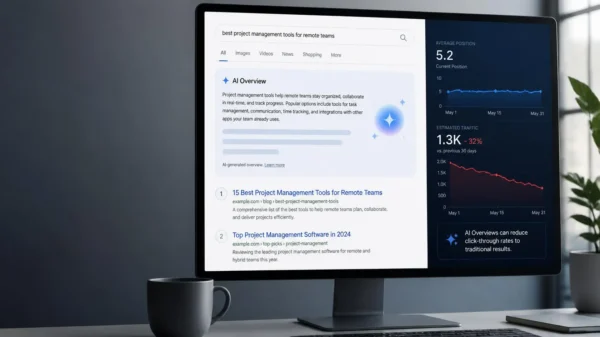
Here’s a simple Illustrative example example of what this can look like in Google Search Console.
Impressions
Clicks
Average Position
CTR
Example
Imagine your page has:
Before
- Average position: 4.2
- Impressions: 20,000
- Clicks: 1,500
- CTR: 7.5%
After
- Average position: 4.4
- Impressions: 20,500
- Clicks: 1,100
- CTR: 5.4%
Then explain:
The ranking barely changed and impressions actually increased, but clicks decreased. That is a signal worth investigating at the SERP level.
The Opportunity Hidden Inside AI Search
There is another side to this conversation.
AI-driven search isn’t only a threat.
If you’re also exploring how AI is changing the way websites communicate with search and AI systems, you can read our guide on llms.txt and what it actually means for websites. If you’re also exploring how AI is changing the way websites communicate with search and AI systems, you can read our guide on llms.txt and what it actually means for websites.
It can also create new opportunities.
When search engines use information from websites to generate answers, being recognized as a useful source can become valuable.
That means your goal shouldn’t simply be:
How do I get position one?
Think bigger:
What’s the path to becoming a trusted reference point for this subject?
That requires strong content, clear information, original insights, good website structure, and a reputation for being useful.
What About Clicks From AI Overviews?
This is where things become more complicated.
A site can show up inside an AI-generated answer without receiving the same click-through it might normally get from a standard organic listing.
Therefore, measuring SEO only through traditional ranking reports can become increasingly incomplete.
Website owners should pay attention to the full journey:
Search → visibility → click → engagement → conversion
A decline in one step doesn’t necessarily mean your entire SEO strategy has failed.
You need to identify exactly where the change occurred.
A Simple AI Overview Traffic-Drop Checklist
If your rankings look stable but organic traffic is declining, work through this checklist:
Step 1: Open Google Search Console and review your Performance report.
Step 2: Compare your current clicks with a previous period.
Step 3: Check whether impressions changed.
Step 4: Check whether average position changed.
Step 5: Look for CTR changes.
Step 6: Identify the pages responsible for the largest click losses.
Step 7: Identify the queries responsible for those losses.
Step 8: Search those queries manually.
Step 9: Look at the current SERP features.
Step 10: Compare the search intent with your content.
Step 11: Improve the page where there is a genuine content gap.
Step 12: Monitor the results before making additional major changes.
This process is much safer than immediately rewriting dozens of pages.
Don’t Confuse Lower Clicks With Lower Rankings
This is probably the most important lesson.
SEO isn’t only about where your website ranks.
A page can maintain a strong position while the search environment around it changes.
That’s why you need to watch both ranking performance and traffic behavior.
If your rankings are stable but clicks are falling, investigate the search results before assuming that your content has suddenly become bad.
The answer may be much more complicated.
What Should You Do With Your Existing Content?
Start with your pages that already have:
- Good impressions
- Strong rankings
- Falling CTR
- Falling clicks
These pages are often more interesting than pages that have almost no visibility.
Why?
Because they already have Google visibility.
Instead of starting from zero, you can improve what already works.
Look at the page and ask:
Does it answer the query better than the competing results?
Does it provide something original?
Does it give readers a reason to click?
Could the introduction be more useful?
Are there practical examples?
Are there clear next steps?
Could the title better communicate the benefit?
These questions can lead to much more meaningful improvements than simply adding more keywords.
Frequently Asked Questions
Can AI Overviews reduce organic traffic?
AI Overviews may affect organic clicks for some searches by providing users with information directly on the Google results page. However, a traffic decline does not automatically mean AI Overviews are responsible. Search demand, rankings, competitors, seasonality, and other SERP features can also affect organic traffic.
Can my Google rankings stay the same while traffic decreases?
Yes. Your average ranking can remain relatively stable while clicks decline. Changes in search results, click-through rate, search intent, and SERP features can influence how many people click an organic result. That’s why it’s important to monitor impressions, clicks, CTR, and average position together.
How can I tell if AI Overviews are affecting my website traffic?
Start with Google Search Console. Compare your clicks, impressions, CTR, and average position over different periods. If rankings and impressions remain fairly stable while CTR and clicks decline, manually search your important queries and check whether AI Overviews or other SERP features are appearing.
Should I stop publishing informational content because of AI Overviews?
No. Informational content can still attract valuable visitors. Instead of publishing basic definitions that provide little additional value, focus on detailed explanations, original examples, screenshots, practical advice, comparisons, and solutions that go beyond a quick answer.
How can I make my content more useful in an AI-driven search environment?
Create content that gives readers a reason to visit your website. Include original insights, real examples, step-by-step instructions, screenshots, data, comparisons, checklists, and practical recommendations where appropriate. Focus on satisfying the user’s search intent rather than simply adding more keywords.
What should I check first when my organic traffic drops?
Start with Google Search Console. Compare clicks, impressions, CTR, and average position with a previous period. Then identify which pages and search queries lost the most clicks. Check those queries manually to see whether rankings, search intent, competitors, or SERP features have changed before making major SEO changes.
Final Thoughts
The AI Overview conversation is often framed as a simple battle between AI and websites.
The reality is more complicated.
Google search is changing, and the traditional relationship between ranking and traffic is changing with it.
If your rankings remain stable but your organic clicks decline, don’t immediately assume that your website has been penalized or that your SEO has failed.
Look at the entire search experience.
Check your impressions.
Check your CTR.
Check your important queries.
Search them yourself.
Look at what appears above your result.
Then improve the pages where you can genuinely provide more value.
The future of SEO may not be about getting every searcher to click.
It may be about becoming the source people trust when they do decide they need more than a quick answer.
And that is why the smartest SEO strategy for 2026 isn’t simply: Rank higher.
It’s: Become more useful.