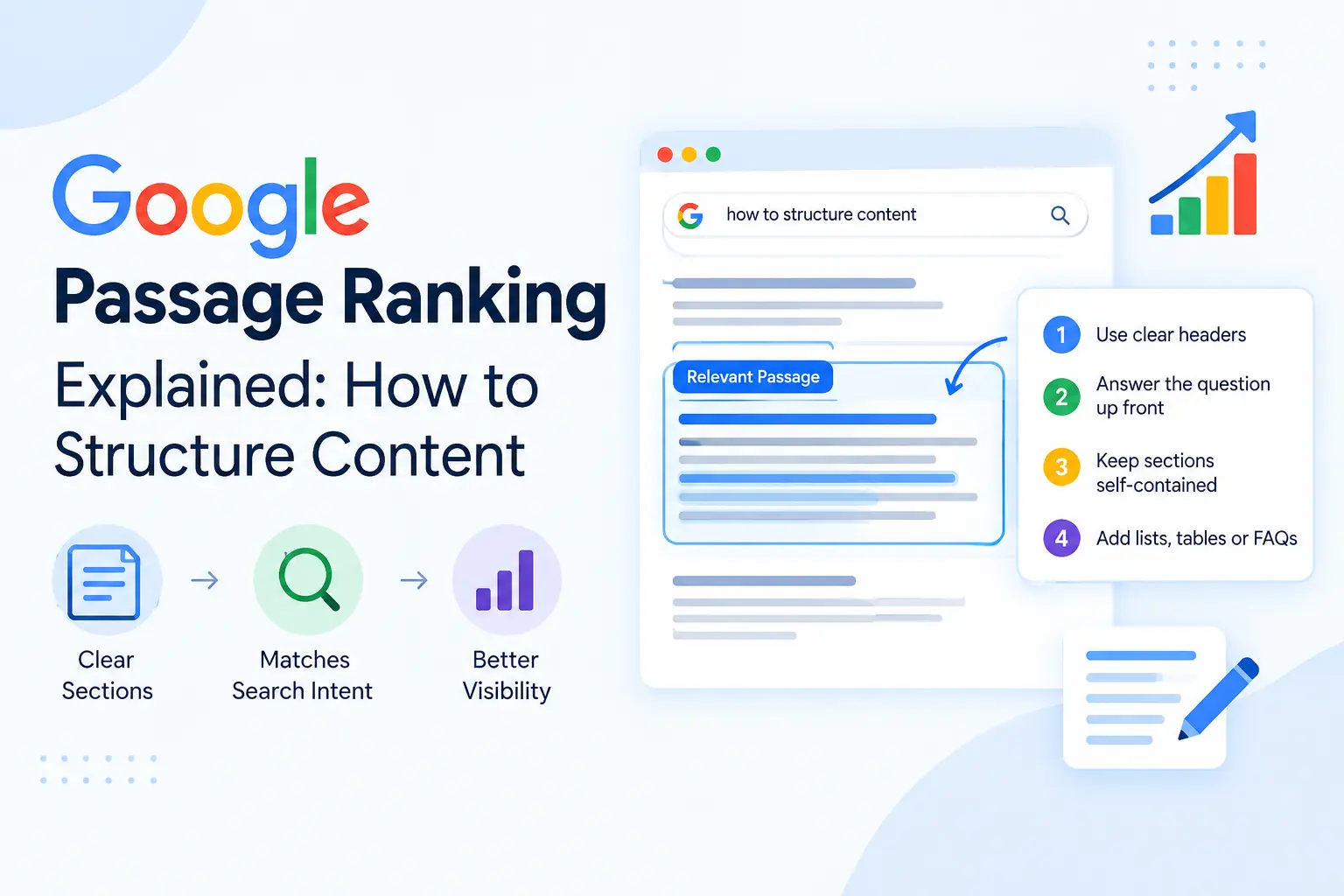
Google passage ranking is Google’s ability to understand and identify relevant information within specific sections of a webpage. It can help Google surface a useful section of a page when that section closely matches what someone is searching for, even when the page covers a broader topic.
In this guide, you’ll learn what Google passage ranking means, how passage-level understanding works, common misconceptions about it, and how to structure your content so important information is clear, useful, and easy to understand.
Important: Passage ranking does not mean Google treats every paragraph as a separate webpage. Your entire page still needs to be relevant, useful, accessible, and aligned with search intent.
In this guide, we’ll explain what Google passage ranking means, how passage-level understanding fits into modern search, and how you can structure your content so important sections are clear, useful, and closely aligned with search intent.
What Is Google Passage Ranking?
Passage ranking is Google’s ability to understand the meaning and relevance of specific sections within a webpage. This can help Google identify information that is particularly useful for a search query, even when the overall page covers a broader topic.
However, passage ranking does not mean that Google ignores the rest of the page or ranks individual paragraphs completely independently. Overall page relevance, content quality, usability, and other search signals still matter.
For website owners, the practical lesson is simple: don’t create isolated paragraphs just to target search engines. Instead, organize your content around real questions and make important sections clear enough that readers can quickly understand the information they need.
Clear content structure can make information easier for readers and search systems to understand. However, rankings depend on multiple factors, including relevance, content quality, usability, and search intent. However, rankings depend on multiple factors, including relevance, content quality, and search intent.
For more information about how Google Search works, see the official Google Search ranking systems documentation.
Is Passage Ranking the Same as Passage Indexing?
No. Passage ranking and indexing are different concepts.
Indexing is the process through which Google discovers, processes, and stores information about webpages so that they can potentially appear in Search. Google’s Search documentation describes Search as a process involving crawling, indexing, and serving results.
Passage ranking, on the other hand, is a ranking system that helps Google identify relevant sections within webpages when evaluating their relevance to a search query.
In simple terms:
- Crawling: Google discovers a page.
- Indexing: Google processes and stores information about the page.
- Ranking: Google’s systems determine which results are relevant to a query.
- Passage ranking: One of Google’s systems helps understand relevant sections within webpages.
So, you should not think of passage ranking as Google creating a separate search index containing every paragraph on your website.
Passage Ranking vs Other Google Search Concepts
| Concept | What it means |
|---|---|
| Crawling | Google discovers webpages and follows links across the web. |
| Indexing | Google processes and stores information about discovered pages. |
| Ranking | Google’s systems determine which results are relevant to a particular query. |
| Passage ranking | An AI system that helps Google identify relevant sections within webpages. |
| Page experience | Google’s systems consider various aspects of the overall experience provided by a page. |
How Does Google Passage Ranking Work?
Google’s passage ranking system helps its automated systems identify individual sections, or passages, within a webpage that may be especially relevant to a search query. Google describes passage ranking as an AI system used to identify individual sections of a webpage to better understand how relevant the page is to a search.
A simple way to understand the process is:
- Google discovers and indexes a webpage.
- Google analyzes the page’s content and meaning.
- A search query is matched against relevant information.
- Google can identify a particularly useful section within a broader page.
- The page can then be considered as a relevant result for that query.
This does not mean that every paragraph becomes an independent search result. Passage-level understanding works as part of Google’s broader ranking systems, which use many signals to determine which pages are relevant and useful for a particular search.
For content creators, the practical lesson is simple: organize information clearly, answer specific questions directly, and provide enough context for each section to be useful on its own.
Why Passage-Level Understanding Still Matters in 2026
Passage-level understanding remains useful because modern search systems need to interpret detailed information within webpages. A single article can cover several related questions, and different sections can provide different pieces of useful information.
This is also relevant as search experiences increasingly provide direct answers and AI-generated summaries. However, passage-level understanding should not be treated as the system responsible for AI Overviews or other AI-powered Search features. Google’s modern Search experiences use multiple systems and signals to understand queries, find relevant information, and present results.
For a broader look at making your content useful and understandable for AI-powered search systems, see our guide on how to get cited by ChatGPT and Perplexity.
Changes in the search results page can also affect how users interact with organic listings. For some queries, users may receive enough information directly from search features that they have less reason to click a traditional organic result.
If your traffic changes, don’t automatically assume passage ranking is responsible. Check your Google Search Console data to see which pages, queries, impressions, clicks, and average positions have changed.
Does Google Rank Paragraphs Instead of Pages?
Passage ranking helps Google’s systems identify relevant sections within a webpage so the page can be better understood for a particular search query. Google’s ranking systems continue to evaluate pages using many signals and systems.
For example, imagine you publish a 2,500-word guide about SEO. One section explains how to improve Google Search Console average position, while another discusses keyword research.
A user searching for a specific question about average position may find the page relevant because the page contains a particularly useful section answering that question.
The lesson is not to create hundreds of tiny pages or paragraphs. Instead, organize comprehensive content into clear sections that answer real questions.

How to Structure Your Content for Better Passage-Level Understanding
Here’s the practical part — the actual changes you can make to your content today.
Google also recommends creating helpful, reliable, people-first content rather than writing primarily to manipulate search rankings. See Google’s guidance on creating helpful, reliable, people-first content.
1. Answer the Question in the First Two or Three Sentences
Every major section of your article should open with a direct, clear answer to the question implied by its heading. Save the nuance, examples, and extra detail for after that opening answer. Opening with a direct answer improves clarity for readers and makes the purpose of the section immediately obvious. Don’t treat this as a guaranteed passage-ranking technique; focus on usefulness and clarity first.
2. Use Descriptive, Question-Based Headers
Instead of vague headers like “Our Approach” or “More Details,” use headers that mirror real search queries: “How Does Passage Ranking Work?” or “What Should You Do About It?”. Descriptive headings help readers and search engines understand what each section covers and make the page’s structure clearer.
3. Keep Each Section Self-Contained
A well-structured section should make sense to readers without requiring excessive context from other parts of the article. Avoid heavy reliance on phrases like as mentioned above or like we said earlier — make important information clear within the section itself.
4. Add Supporting Structure: Lists, Tables, and FAQs
Lists, tables, and FAQs can make complex information easier for readers to scan and understand. Use them when they genuinely improve the presentation of the information rather than adding them simply for SEO.
For example, a comparison table can summarize several options quickly, while an FAQ section can answer closely related questions that readers commonly have.
5. Back Up Claims With Specific, Original Detail
Specific examples, original observations, supporting evidence, and useful details can make an article more valuable and distinguish it from generic content.
If you use AI during your writing process, you can also read whether Google penalizes AI-written content in 2026 to learn more about creating useful, people-first content.
6. Don’t Panic and Rewrite Everything at Once
Don’t assume that changes in your rankings are automatically caused by passage-level understanding or AI features in Search. Google uses many systems and signals to evaluate search results, and ranking changes can have different causes.
Before making major changes, check your own Google Search Console data to identify which pages and queries changed. You can also learn how to improve average position in Google Search Console and use those insights to make targeted improvements.
Rather than rewriting your entire website at once, improve one section or page at a time and monitor the results.
If a page is indexed but still receiving very little traffic, review your impressions, rankings, search intent, content quality, and internal links. Our guide on why a website can be indexed but not getting traffic explains how to diagnose these problems step by step.
Example: Turning a Vague Section Into a Clear Answer
Imagine you’re writing an article about improving Google Search Console performance.
A vague heading might be:
Improving Your Results
The section could discuss several unrelated ideas before explaining what the reader should actually do.
A clearer heading would be:
How Do You Improve Average Position in Google Search Console?
The section can then begin with a direct answer:
To improve average position in Google Search Console, identify keywords ranking between positions 11 and 20, improve the relevant page’s content and search intent alignment, strengthen internal links, and monitor the results over time.
The explanation and examples can follow underneath.
This structure is useful because the reader immediately knows what the section answers. It also makes the topic and purpose of the section clearer to search engines.
Common Passage Ranking Misconceptions
Passage ranking is often misunderstood. Here are some common misconceptions.
Google ranks individual paragraphs independently
Not exactly. Passage-level understanding helps Google identify relevant information within a webpage, but it does not mean every paragraph becomes an independent webpage with its own ranking.
Every paragraph should target a separate keyword
No. Writing naturally around related topics and questions is more useful than forcing a different keyword into every paragraph.
Passage ranking means you should write extremely long articles
Not necessarily. Length alone does not make content more useful. A shorter article that answers a searcher’s question clearly can be more useful than a longer article filled with unnecessary information.
Adding FAQs guarantees passage rankings
No. FAQs, lists, and tables should be used when they genuinely help readers. There is no guaranteed format that makes a passage rank.
Passage ranking is the same thing as AI Overviews
No. Passage-level understanding and AI-powered Search features are not the same system. Modern Search uses multiple systems to understand queries and information.
A Simple Passage-Ranking Checklist
-
- Open important sections with a direct answer
- Use descriptive subheadings that clearly communicate the topic
- Make important sections understandable without excessive context
- Use lists, tables, or FAQs when they genuinely improve clarity
- Add specific examples, evidence, and original insights where appropriate
- Review Google Search Console data before making major sitewide changes
- Focus on satisfying search intent rather than trying to optimize individual paragraphs for Google
Passage Ranking and Search in 2026
Search is continuing to evolve beyond traditional blue-link results. Google now provides AI-powered Search experiences that can summarize information and help users explore topics through multiple sources.
If you want to understand how Google Search Console is providing more visibility into AI-powered Search, read our guide to Search Console AI reports in 2026.
For website owners, this makes clear content structure increasingly useful. Important information should be easy to understand, supported by evidence where appropriate, and organized around the questions readers actually have.
At the same time, don’t assume that passage-level optimization alone determines whether a page appears in traditional Search or newer AI-powered experiences. Search visibility depends on multiple factors, so use Google Search Console and your analytics data to understand how your own pages are performing.
Common Passage Ranking Mistakes to Avoid
Trying to optimize specifically for passage ranking can lead to unnecessary changes. Avoid these common mistakes:
- Don’t create extremely short paragraphs just for Google.
- Don’t repeat the same keyword unnaturally.
- Don’t create dozens of pages that cover almost identical topics.
- Don’t assume every paragraph can rank independently.
- Don’t remove useful context simply to make sections shorter.
- Don’t write primarily for search engines instead of readers.
The goal should be useful, well-organized content. Google says its ranking systems are designed to prioritize helpful, reliable information created for people rather than content created primarily to manipulate Search rankings.
Frequesntly Asked Questions
What is Google passage ranking?
Google passage ranking is an AI system Google uses to identify individual sections or passages within webpages to better understand how relevant a page is to a search query.
Does Google rank individual paragraphs?
Not in the sense that every paragraph becomes an independent webpage. Passage ranking helps Google identify relevant sections within a webpage while its broader ranking systems evaluate pages using multiple signals.
Does passage ranking help long-form content?
A longer article can contain useful information for multiple related searches, but length alone does not guarantee better rankings. Clear organization, relevance, usefulness, and satisfying search intent remain important.
How do I optimize content for passage ranking?
Focus on clear headings, direct answers, useful explanations, logical organization, and content that genuinely satisfies the reader’s question. There is no guaranteed passage-ranking trick.
Is passage ranking the same as Google AI Overviews?
No. Passage ranking is a Google ranking system used to help understand relevant sections of webpages. AI Overviews are a separate Search feature that can provide AI-generated responses and links to supporting webpages.
Final Thoughts
Google passage ranking is best understood as part of Google’s ability to understand relevant information within webpages. It does not mean that individual paragraphs are completely independent ranking units, nor does it provide a special trick for ranking content.
Instead of trying to optimize isolated passages, focus on creating useful pages with clear sections, descriptive headings, direct answers, relevant examples, and information that satisfies search intent.
As search continues to evolve, review your existing articles section by section. Ask yourself: If a reader landed directly on this section, would they understand the answer without searching through the rest of the page?
If the answer is no, improve the section for clarity and usefulness first. That approach is more sustainable than trying to write specifically for an assumed passage-ranking formula.
If you’re serious about staying visible as search evolves, start by revisiting your best-performing pages and asking one simple question for every section.