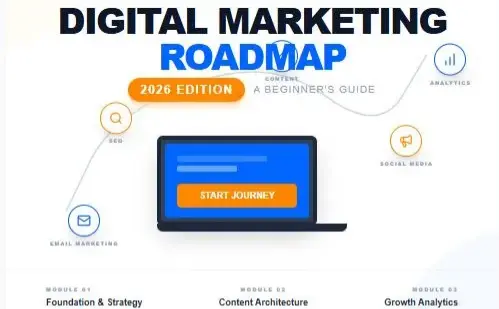
Beginner Digital Marketing Roadmap 2026 (No Budget Step-by-Step Guide)
Learn digital marketing from zero with no budget. This beginner roadmap for 2026 gives you free tools and a clear step-by-step plan to start today.
Are you a complete beginner who wants to learn digital marketing but has no money to spend? You’re in the right place. This free beginner digital marketing roadmap for 2026 will show you exactly where to start, what to learn, and which free tools to use — all without spending a single rupee or dollar. Whether you’re a student, freelancer, or small business owner, this step-by-step guide will take you from zero to your first real digital marketing result in 2026.

What Is Digital Marketing and Why Learn It in 2026?
Digital marketing is the process of promoting products, services, or personal brands through online channels such as search engines, social media, email, and websites. Unlike traditional marketing, digital marketing allows anyone to reach a global audience with little to no budget.
In 2026, learning digital marketing is one of the most valuable investments of your time because:
- Businesses are actively hiring digital marketers at competitive salaries
- Freelancers can earn income from anywhere in the world
- Small business owners can grow their brand without paying for expensive advertising
- The skills you learn today will remain relevant and in demand for years to come
The barrier to entry is low, the resources are free, and the opportunities are enormous. All that is required is consistency and a willingness to learn.
What You Need Before You Start (No Budget Checklist)
Before diving into the roadmap, confirm that you have the following — all of which are completely free:
- A smartphone or computer with internet access
- A free Gmail account (used to access Google tools)
- A free account on WordPress.com or Blogger (for your practice website)
- A free Canva account (for creating graphics)
- A free Mailchimp account (for email marketing practice)
- A notebook or free Google Doc to track your progress
That is all. You do not need to purchase any software, course, or tool to begin this journey.
Step 1: Understand the Foundations of Digital Marketing
Before learning any specific skill, it is essential to understand how digital marketing works as a whole. Many beginners make the mistake of jumping directly into running ads or posting on social media without first understanding the fundamentals. This leads to wasted effort and frustration.
What to learn in Step 1:
- The difference between organic and paid marketing
- The main digital marketing channels: SEO, content marketing, social media, email, and paid advertising
- How the customer journey works — from awareness to purchase
- Basic marketing psychology and why people buy online
Free resource to use: Google Digital Garage — “Fundamentals of Digital Marketing” (free and internationally certified). Just search the “Google Digital Garage” to access it.
Time required: 1 to 2 weeks
Step 2: Build Your Online Presence for Free
Every digital marketer needs a practice ground. The best way to learn is by doing, and building a free website or blog gives you a real platform to apply what you learn.
How to build your free online presence:
- Launch a free blog using WordPress.com or Blogger.
- Choose a simple niche topic you are interested in (cooking, fitness, travel, technology)
- Write your first 3 to 5 blog posts on that topic
- Set up free social media profiles on Instagram, Facebook, and LinkedIn using your blog’s name
This practice website will serve as your portfolio. It demonstrates real, practical experience to future clients or employers — even if you have zero professional experience at this stage.
Free tools to use: WordPress.com, Blogger, Canva (for blog graphics)
Time required: 1 week
Step 3: Learn SEO Basics Using Free Tools
Search Engine Optimization (SEO) is the practice of optimizing your website so that it appears on the first page of Google search results. SEO is one of the most in-demand digital marketing skills in 2026 and it costs nothing to learn or practice.
What to learn in Step 3:
- How Google ranks websites and blog posts
- Keyword research — finding words and phrases people search for
- On-page SEO — writing titles, headings, and meta descriptions correctly
- How to write SEO-friendly blog posts
Free tools to use:
- Google Search Console — Optimize your SEO by tracking your site’s organic performance.
- Google Keyword Planner — finds keywords people are searching for.
- Ubersuggest Free Version — shows keyword difficulty and competition.
- Yoast SEO (WordPress plugin) — guides you to optimize each blog post.
Practical exercise: Write one blog post targeting a specific keyword and optimize it using Yoast SEO. Then submit it to Google Search Console and monitor the results over the following weeks.
Time required: 2 to 3 weeks
Step 4: Start Content Marketing with Zero Budget
Content marketing is the practice of creating valuable, helpful content that attracts an audience and builds trust over time. In 2026, content remains the single most powerful free marketing strategy available to beginners.
What to learn in Step 4:
- How to write blog posts that rank on Google and provide genuine value.
- How to create simple graphics and visual content using Canva.
- Work Smarter repurposing One Content Asset Across All Platforms.
- How to build a simple content calendar to stay consistent.
Free tools to use:
- Canva — create professional graphics, thumbnails, and social media posts.
- Google Docs— A seamless platform for drafting and structuring your content.
- Hemingway App — improve the clarity and readability of your writing.
- Answer The Public (free version) — find content ideas based on what people are searching.
Practical exercise: Create a simple 4-week content calendar with one blog post and three social media posts per week. Write and publish them consistently on your practice website and social profiles.
Time required: Ongoing — begin in Week 3 and continue throughout.
Step 5: Grow on Social Media Organically
Social media is one of the most accessible free marketing channels available to beginners. Organic growth — growing without paid advertising — requires consistency, quality content, and genuine engagement with your audience.
What to learn in Step 5:
- How each platform’s algorithm works (Instagram, Facebook, LinkedIn, TikTok).
- How to write captions that drive engagement.
- The best times to post on each platform.
- How to use hashtags effectively.
- The Essential Guide to Cultivating Community Through Meaningful Engagement.
Free tools to use:
- Meta Business Suite — schedule posts for Instagram and Facebook for free.
- Buffer Free Plan — schedule up to 10 posts across platforms.
- Canva — create visually consistent social media content.
Practical exercise: Choose one primary social media platform and commit to posting consistently for 30 days. Track your follower count, reach, and engagement at the end of each week and adjust your strategy based on the results.
Time required: 2 to 3 weeks to learn; ongoing to practice
Step 6: Use Free Email Marketing Tools
Consistently outperforming other digital channels in ROI, email marketing provides the unique advantage of direct audience ownership without third-party interference.
What to learn in Step 6:
- From Zero to Subscriber: How to Build Your Email List from Scratch.
- The Science of the Click: Writing Subject Lines That Drive Opens.
- How to structure a simple email newsletter.
- How to segment an audience and send targeted messages.
Free tools to use:
- Mailchimp Free Plan — send up to 1,000 emails per month for free
- Brevo (formerly Sendinblue) Free Plan — send up to 300 emails per day for free
Practical exercise: Create a free Mailchimp account and set up a simple lead magnet — for example, a free checklist or guide — to encourage visitors to your blog to subscribe to your email list. Send one email newsletter per week to your subscribers.
Time required: 1 to 2 weeks
Step 7: Track Your Results with Free Analytics
One of the most important skills that separates professional digital marketers from beginners is the ability to measure and interpret data. Tracking your results allows you to understand what is working, what is not, and how to improve your strategy over time.
What to learn in Step 7:
- How to read Google Analytics reports
- How to understand key metrics: traffic, bounce rate, session duration, conversions
- How to use Google Search Console to monitor your SEO performance
- How to track social media insights on each platform
Free tools to use:
- Google Analytics 4 (GA4) — tracks all traffic and user behaviour on your website
- Google Search Console — Gain deep insights into how your site appears and performs in Google Search results.
- Native social media analytics — Instagram Insights, Facebook Page Insights, LinkedIn Analytics.
Practical exercise: Install Google Analytics on your practice website. After 30 days of publishing content, review your top-performing pages and identify which topics attract the most visitors. Use this data to guide your future content strategy.
Time required: 1 week to learn; ongoing to monitor
Step 8: How to Get Your First Client or Job with No Budget
Once you have completed the previous steps and built a portfolio of real work on your practice website, you are ready to pursue your first client or entry-level digital marketing opportunity.
How to get your first client with no budget:
- Offer free or heavily discounted services to one local business in exchange for a testimonial
- Create a detailed case study showing the results you achieved on your practice website
- Apply for entry-level digital marketing internships or remote jobs on platforms such as LinkedIn, Indeed, and Rozee.pk
- Offer your services on Fiverr or Upwork starting at a competitive beginner rate
- Join digital marketing Facebook groups and LinkedIn communities to network with professionals
What to include in your portfolio:
- Your practice website with published blog posts
- Before and after screenshots of your SEO improvements in Google Search Console
- Social media growth reports from your 30-day content challenge
- Any email marketing campaigns you have created
Your portfolio does not need to be perfect. It needs to demonstrate that you have real, practical knowledge and the ability to produce results.
- “Free AI Tools for Digital Marketing Beginners” — mention ChatGPT (free), Canva AI, Google Gemini. This is very searchable in 2026.
- “Free Certifications to Get as a Beginner” — Google Digital Garage, HubSpot Academy, Meta Blueprint. People search this a lot.
- “Short-Form Video Marketing for Beginners” — YouTube Shorts, Instagram Reels, TikTok. Add this as Step 5.5 or expand your social media step.
Final Thoughts: Your No-Budget Roadmap Starts Today
Starting digital marketing with no budget is completely possible in 2026. Every tool mentioned in this guide — Google Analytics, Google Search Console, Canva, Mailchimp, WordPress — is available for free. The only investment required is your time and your commitment to consistent practice.
Follow each step of this roadmap in order. Do not skip ahead. Build your foundation before attempting advanced strategies. Focus on one skill at a time, apply it on your practice website, track your results, and improve continuously.
If you complete this roadmap over the next 60 to 90 days, you will have more practical digital marketing knowledge and experience than the majority of beginners who are still searching for the perfect paid course to get started.
Bookmark this guide, follow each step, and begin today. The best time to start was yesterday. This is the the best time to get in is now.
FAQ:
Q1: What is a digital marketing roadmap?
A digital marketing roadmap is a step-by-step plan that helps beginners learn and implement marketing strategies effectively. It guides you through the right skills in the right order so you don’t waste time or money.
Q2: How long does it take to learn digital marketing?
You can expect to achieve initial results within three to six months as you solidify your foundational skills. However, if you follow this roadmap consistently, you can build a solid foundation in just 60 to 90 days.
Q3: Is digital marketing a good career in 2026?
Yes, digital marketing is one of the fastest-growing and highest-demand skills worldwide. Businesses of every size need digital marketers, and the career offers both employment and freelancing opportunities.
Q4: Can I learn digital marketing without a degree?
Absolutely. Digital marketing is a skills-based field. Employers and clients care about results, not degrees. A strong portfolio with real results matters far more than any certificate or qualification.
Q5: Which digital marketing skill should I learn first?
Start with the fundamentals of digital marketing, then move into SEO. SEO is the foundation of most other digital marketing activities and gives you the best long-term results without any budget.
Q6: How do I get my first digital marketing client?
Offer free or discounted services to a local business in exchange for a testimonial. Build a portfolio from your practice website, then apply on Fiverr, Upwork, or LinkedIn. Your first client is about proving yourself, not earning big.
Q7: How much can a beginner digital marketer earn?
A beginner can earn anywhere from $200 to $800 per month as a freelancer, depending on skills and location. With experience, digital marketers can earn $1,500 to $5,000+ per month. In Pakistan, entry-level salaries typically range from PKR 30,000 to PKR 80,000 per month.
Q8: Is SEO or social media better for beginners?
Both are valuable, but SEO is better for long-term, sustainable traffic while social media gives faster visibility. This roadmap recommends learning SEO first and then adding social media as a second channel.
If this guide helped you, share it with someone who wants to start digital marketing for free in 2026.